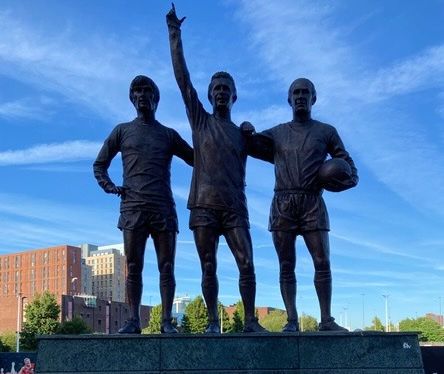
Three routes into one rebuilt team
The name “Holy Trinity” can make the partnership sound as though it arrived fully formed. It did not. Sir Bobby Charlton was the link to the Busby Babes: a product of United’s youth system, a first-team player from 1956 and a survivor of the Munich air disaster. He returned to become a central figure in the reconstruction, carrying both sporting responsibility and a history that neither of the other two shared.[1]
Denis Law arrived by transfer in July 1962. United paid Torino a British-record fee of £115,000 for a forward already proven in England and Italy. Law’s debut came against West Bromwich Albion that August, and his first season ended with an FA Cup final goal in the 3–1 victory over Leicester City. The trophy was United’s first since Munich and gave the developing side a concrete success before it became a league champion.[2]
George Best represented a third route. Recruited from Belfast and developed within United’s youth structure, he made his senior debut against West Brom in September 1963 at 17. When all three started together against the same opponents at The Hawthorns in January 1964, United won 4–1 and Best, Law and Charlton supplied every goal. It is a convenient beginning for the trio’s public story, but their importance grew over seasons rather than in one afternoon.[3]
Contrasting strengths, shared space
Their collective power came from difference. Best could begin wide, receive under pressure and disturb a defensive shape through close control, acceleration and changes of direction. His game created uncertainty: a full-back could be isolated, a second defender drawn across and space opened inside. The danger was not confined to supplying others. Best also became a prolific scorer, notably leading United’s scoring in the European Cup-winning 1967–68 season.
Law played nearer the penalty area and with a striker’s appetite for the decisive touch. He attacked rebounds, crosses and small changes in the ball’s path, but reducing him to finishing misses his movement and competitive intensity. He could combine quickly, pull defenders away from central positions and turn half-chances into shots. His 237 goals in 404 United appearances record the output; the pace and aggression of his play explain why supporters called him “the King.”[4]
Charlton brought range. His running could carry the ball through midfield, while his power from distance forced opponents to defend beyond the penalty area. He could operate from the left or through the centre and offered a bridge between build-up and attack. Across 758 United appearances he scored 249 goals, both club records when he left, while his stamina and positional adaptability gave the side a different kind of continuity.[5]
Champions in 1965 and 1967
The 1964–65 league title was the clearest proof that Busby’s new side had matured. United finished level on points with Leeds United and won the championship on goal average, the method then used to separate teams. Law’s goals, Charlton’s drive and Best’s increasingly influential wing play helped turn the promise of the previous season into United’s first league title since 1956–57.[6]
The following campaign brought no trophy, although it produced one of the era’s defining European performances: a 5–1 European Cup quarter-final victory away to Benfica, with Best scoring twice. United then fell to Partizan Belgrade in the semi-final. That sequence is a useful corrective to a simple story of inevitable ascent. A side containing three outstanding attackers could still be stopped, and knockout football repeatedly denied this team additional silverware.
United recovered to win the league again in 1966–67, this time by four points. That title returned them to the European Cup and supplied the platform for 1968. The Trinity were the brightest names, but the championship also rested on a settled defence, Stiles and Crerand’s midfield work, and the goals of players beyond the celebrated three.
Three Ballons d’Or in five years
The individual awards reveal the unusual concentration of talent. Law won the Ballon d’Or in 1964, Charlton in 1966 and Best in 1968. France Football’s roll of honour confirms three United winners within five award cycles, each representing a different national team: Scotland, England and Northern Ireland.[7]
Those dates also show how the centre of attention moved. Law’s award followed the goals and momentum that preceded the 1965 title. Charlton’s came in the year he helped England win the World Cup. Best’s followed United’s European Cup and a season in which his combination of invention and scoring reached its peak. The awards were individual, but their sequence strengthened the later idea of a single golden constellation at Old Trafford.
Wembley glory—and an important absence
The 1968 European Cup final is often presented as the Trinity’s crowning match. That description needs one qualification: Law did not play. A knee injury required surgery, leaving him to follow the 4–1 extra-time victory over Benfica from hospital. His absence does not remove him from the season or the rebuilding project, but it matters when describing the final itself.[8]
Charlton captained United and scored twice, first heading the opening goal and later completing the scoring. Best put United ahead in extra time before Brian Kidd, playing on his nineteenth birthday in Law’s place, added the third. UEFA records the result as the first European Cup victory by an English club.[9]
The final therefore joins the trio’s shared history to the wider squad’s achievement. Best and Charlton shaped the night on the pitch; Law’s goals had helped create the era but injury kept him outside the team. Kidd, John Aston Jr, Alex Stepney and the rest were not supporting characters in a monument to three men. They were European champions in their own right.
Fame, strain and the end of the era
Best’s appeal stretched beyond football. His skill, Belfast background, clothes and public image made him a recognisable figure in a changing media culture. That visibility helped expand United’s glamour, but it also encouraged later retellings to flatten a complicated career into celebrity. On the field, his value lay in repeated actions—beating defenders, creating imbalance and scoring—not simply in the image built around him.
Law’s recurring knee trouble reduced his availability, while Charlton’s longevity allowed him to remain a first-team presence as the side around them aged. Busby stepped down as manager in 1969. Best’s final competitive appearance for United came in 1974 after periods of absence; Charlton left in 1973 after 17 years in the first team; Law also departed in 1973 and joined Manchester City. By then the great 1960s team had not been renewed successfully, and United were relegated in 1974.
That decline does not diminish what the trio achieved, but it sets boundaries around the legend. Their peak was brilliant and relatively concentrated. United won two league titles while all three were established first-team figures, and the club conquered Europe in a season to which all contributed even though only Best and Charlton appeared in the final.
Why the Trinity endured
The name endures because it compresses a complex period into three vivid football identities: Best the elusive dribbler, Law the predatory finisher and Charlton the powerful, far-ranging survivor. Each came from a different part of the United story—recruitment from Belfast, a record transfer from Torino, and the youth system that had produced the Babes. Together they made the rebuilt side feel both new and continuous.
The statue outside Old Trafford fixes that memory in a public place. It shows the three players side by side, facing the stadium where their partnership became famous. The monument is an act of selection, not a complete team sheet. Its value is symbolic: it gives physical form to an era in which United regained the English championship, returned to the summit of European football and produced three club winners of football’s most prominent individual award in five years.
The most accurate tribute is therefore neither to treat the Trinity as a marketing label nor to credit them with every success of the decade. Best, Law and Charlton were three distinct footballers whose talents overlapped at precisely the moment Sir Matt Busby’s rebuilt Manchester United was ready to challenge again. Their partnership mattered because the differences fitted—and because an exceptional team enabled those differences to decide matches.