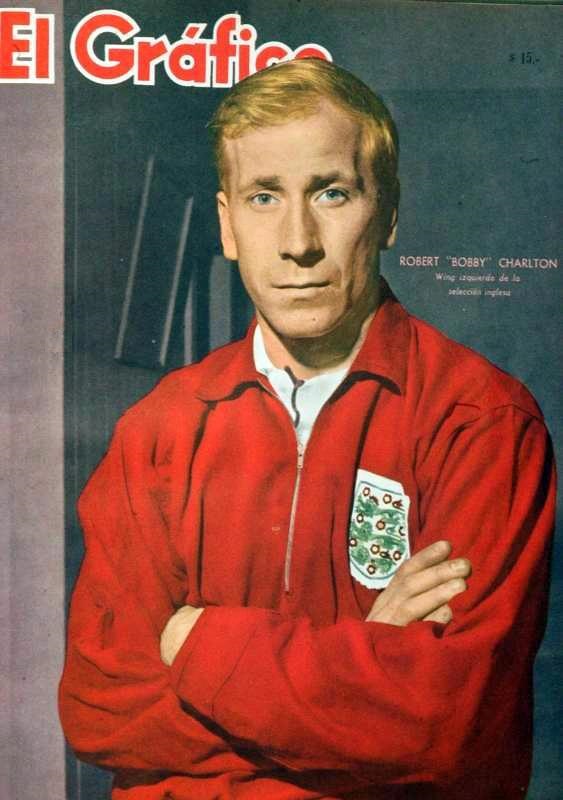
Profile
Sir Bobby Charlton's United career is one of the club's central stories because it contains brilliance, trauma and rebuilding in the same life. He joined as a schoolboy, emerged with the Busby Babes, survived the Munich air disaster and then became the face of the side that finally won the European Cup in 1968. [2] [1]
As a footballer, Charlton was more than a dignified symbol. He carried the ball powerfully, struck shots with rare force and could play from midfield or across the forward line. In the Holy Trinity with Denis Law and George Best, he gave United range: arriving from deeper areas, shooting early and connecting midfield to the forwards. [2]
Munich inevitably shapes how his career is understood, but it should not obscure the level of performance. Charlton won league titles, the European Cup, the Ballon d'Or and the World Cup with England. For United, his two goals in the 1968 European Cup final against Benfica gave the rebuilding story its defining football act. [1]
After leaving United in 1973, he had brief playing and managerial spells elsewhere before returning as a director and ambassador. His importance therefore lasted beyond appearances and goals. Charlton helped define what United wanted to believe about itself: youth, resilience, attacking football and public dignity. [1]
The Archive View
Charlton is central to this archive because he connects the club's deepest trauma with its greatest act of renewal. Many player profiles can be understood through trophies or statistics; Charlton's United career also carries the human continuity between the Busby Babes, Munich and the 1968 European Cup. That continuity is why he appears repeatedly across the club timeline, Munich article and player records.
His footballing value was also unusually broad. Charlton could drive from midfield, strike from range, set tempo and still finish as a forward would. That made him difficult to classify neatly, but historically useful: he helps explain how Busby rebuilt a side that could attack with imagination rather than merely survive on sentiment.
The archive treats Charlton with restraint because his story is often told in elevated language. The verified record is powerful enough without exaggeration. He was a survivor, a standard-bearer and a great footballer; the important editorial task is to show how those roles overlapped across seasons instead of reducing him to any single label.
Charlton also gives the archive a standard for longevity with meaning. Long service alone can be statistical; in his case it carried memory, responsibility and elite performance at the same time. That is why his profile should be read beside the Munich page and the 1967-68 season record, not in isolation. Few United records carry that much football and memory together.
The archive also treats Charlton as a bridge to wider football history. His United career cannot be separated from England, European competition or the global memory of Munich, but this page keeps the club record central. It shows how one player could carry personal achievement and institutional memory together.
United legacy
Charlton sits at the centre of United history because his career carries both football achievement and institutional memory. On the pitch, he gave Busby a player who could strike from distance, move through midfield and provide goals without being fixed to one narrow role. Off the pitch, his survival after Munich and his part in the 1968 European Cup side made him a living connection between loss and recovery. That combination can make the story feel symbolic, but the football remains the base. Charlton mattered because he kept producing elite work while carrying a history few players have ever had to bear.
After Playing And The Weight Of Munich
Charlton's later work with United matters because his club role did not end when he stopped playing. As a director, ambassador and public representative, he became one of the people through whom United presented continuity to the world. That was not merely ceremonial. Charlton's presence connected modern commercial and sporting United to Busby's team, to the recovery after Munich and to the European Cup ambition that had defined the club long before the Premier League era. He gave the institution a living memory at moments when rapid growth might otherwise have made history feel decorative.
The Munich air disaster remained the deepest pain in that memory. Charlton survived while teammates and friends were lost, then had to keep playing inside a club and city grieving around him. His two goals in the 1968 European Cup final are therefore often treated symbolically, but the symbolism rests on football achievement: he was still an elite player ten years after the crash, still able to influence the biggest match in the club's history to that point. The archive should keep both truths visible. Munich shaped his life and United's identity, but Charlton was not only a survivor. He was a great footballer who carried survival into performance, then carried the club's memory into later service.
His later boardroom and ambassadorial presence also shaped how United spoke about itself during the Ferguson era and the global expansion that followed. Charlton gave public dignity to a club becoming larger, richer and more commercial. When United invoked youth, attacking football and recovery from tragedy, he was not an abstract symbol; he was the person in the room who had lived those values. That is why the archive treats his post-playing role as historical content rather than ceremonial aftercare. He helped keep the club's modern identity attached to a real memory of sacrifice and achievement.