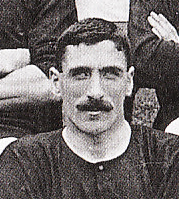
Profile
Billy Meredith belongs to the earliest United story, before the club became a modern global institution. He had already been a major Manchester City player before crossing to United in 1906, and that move carried both football and local significance. United were still shaping their identity; Meredith gave them star power, experience and a right-wing threat that lifted the team immediately.
His career also sits inside the rougher labour politics of early professional football. Meredith was involved in the players' union movement and became associated with debates over wages and control. The 1905 bribery scandal and his suspension are part of the public record, but they should not reduce him to controversy. They also show how unstable and contested the football profession was at the time.
On the pitch, Meredith was a right winger with goals, stamina and unusual durability. He played wide but was not merely a crosser. He could carry the ball, score and give United a repeated route of attack at a time when tactical systems and pitches demanded physical endurance as much as technique.
United's first league titles and the 1909 FA Cup win belong partly to his influence. Ernest Mangnall's side had other important figures, including Charlie Roberts and Sandy Turnbull, but Meredith was the famous attacking reference point. His presence helped United move from ambitious club to trophy-winning club.
He later returned to Manchester City and continued playing deep into an age by which most footballers had long since stopped. That longevity can make the career feel almost unreal from a modern perspective. For United, Meredith is important because he connects the club's first great side to early football professionalism, Manchester rivalry and the fight over players' rights.
A football celebrity before celebrity culture
Meredith was born in Chirk in 1874 and worked in the coal industry before professional football became a secure occupation. By the time he crossed Manchester in 1906 he was already the game's most recognisable winger, famous for playing with a toothpick in his mouth and for a direct style based on balance, close control and stamina. United were newly promoted and ambitious; acquiring him from Manchester City changed the team's public standing as well as its attack.
The move followed his suspension in the aftermath of a bribery case at City. Meredith denied the central allegation and the episode remains entangled with club politics, testimony and the insecure status of players. It should be recorded without treating a disputed Edwardian scandal as a simple character verdict. What followed is clearer: his United debut on New Year's Day 1907 began the most successful period in the young club's history.[1]
The right wing of the first champions
Ernest Mangnall used Meredith as the attacking supplier on the right, with Sandy Turnbull and other forwards benefiting from his ability to beat a defender and deliver accurately. United won the First Division in 1907/08, the FA Cup in 1909 and another league title in 1910/11. Meredith's contribution was not captured by assists, which were not officially recorded, so later numerical comparisons understate a player whose principal task was creating the final opening.
He also embodied durability. Matches were played on heavy surfaces, with limited treatment and little protection from contact, yet he continued at the highest level into his forties. United's decade histories place him across the Bank Street success, the move to Old Trafford and the disruption of the First World War.[2]
The union struggle and a return across Manchester
Meredith helped organise the Association Football Players' Union in 1907. The dispute over the maximum wage and players' freedom brought United's rebels into confrontation with the Football Association; when union members refused to resign, they trained as the “Outcasts” while suspended. The campaign did not remove the wage ceiling, but it established organised player representation as part of football's labour history.
After wartime regional football and the return of the league, Meredith rejoined Manchester City in 1921 and continued playing into his late forties. He later remained a public voice on players' rights and the economics of the game. For United he connects several origins at once: the first champion side, the first Old Trafford team, the Manchester rivalry and the struggle to treat footballers as workers with collective interests. His greatness rests not only on longevity or trophies, but on helping define what a professional player could demand from the sport.[3]
Why Meredith belongs in a modern archive
The scarcity of film and event data makes early players easy to turn into folklore. Meredith is better approached through converging evidence: repeated selection into his forties, trophies at both Manchester clubs, contemporary fame, United's immediate improvement and his central place in union organisation. No one item proves every claim about his style, but together they establish unusual sporting and cultural influence.
His story also corrects the idea that player power is a recent invention. Meredith worked when clubs controlled registration and the maximum wage limited earning power regardless of demand. Organising exposed players to suspension and career risk. His football gave him the public standing to challenge those conditions, while the challenge made his career larger than match results. United acquired a winger and gained an early sporting celebrity whose arguments about labour still sound recognisable.