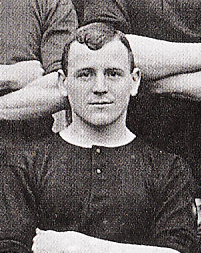
Profile
Charlie Roberts joined United from Grimsby Town in 1904 and became the centre-half and captain of the club's first great side. In an era when United were still establishing themselves, Roberts gave the team leadership through the middle of the pitch and a more modern sense of how a centre-half could influence play.
He was not simply a stopper. Contemporary descriptions point to a player willing to carry the ball and organise from central areas, which made him different from more static defenders of the period. At centre-half he connected defence and attack, and that authority helped Ernest Mangnall's team play with more ambition.
Roberts captained United to league titles and the 1909 FA Cup. Those trophies are foundational because they gave the club its first serious national status. The famous names around him, including Billy Meredith and Sandy Turnbull, supplied attacking glamour, but Roberts supplied structure and command.
His off-field importance is just as notable. Roberts was linked to the players' union movement at a time when professional footballers were pushing against strict wage and control systems. That makes him part of a wider labour history as well as United history. He was not only playing inside early football; he was involved in arguments about what kind of profession football should become.
He left for Oldham Athletic in 1913. United would later pass through decline and rebuilding, but Roberts's place was already secure. He stands as one of the first United captains whose influence extended beyond matches: tactical, cultural and political.
A centre-half who moved the game forward
United signed Roberts from Grimsby Town in 1904 for a substantial fee, and Ernest Mangnall made him the axis of the developing side. The centre-half position then sat between defence and attack, but many players treated it conservatively. Roberts was remembered for carrying the ball and distributing with ambition, behaviour that invited both admiration and criticism in an era with rigid positional expectations.
He was also visually distinctive. Football regulations required shorts below the knee, while Roberts preferred them shorter and repeatedly challenged the rule. The detail can seem trivial, yet it matches a wider career in which he resisted limits—tactical, regulatory and economic—rather than accepting them as permanent.
Captain of the foundational honours
Roberts captained the team promoted in 1906 and then led United to the 1907/08 championship, the 1909 FA Cup and the 1910/11 title. He was also the first captain to lead the club at Old Trafford when the ground opened in February 1910. These achievements created the first durable version of United as a national power, with Roberts organising behind Billy Meredith and Sandy Turnbull.[1]
The team did not play primitive football simply because it belonged to an early era. Mangnall recruited proven talent and built relationships across the pitch. Roberts's forward passing from centre-half helped the side avoid relying entirely on dribbling from the wings. His leadership joined tactical authority to the ceremonial captaincy.
The Outcasts and football as labour
Roberts co-founded the players' union with Meredith and others. When the Football Association demanded that players abandon the organisation in 1909, the United contingent refused, trained separately and became known as the Outcasts. The dispute centred on the maximum wage and freedom of employment: issues that framed footballers not merely as entertainers, but as workers subject to restrictive rules.[2]
He left United for Oldham Athletic in 1913 and later worked in football-related business. His legacy is unusually broad for an early captain. Roberts won the club's first great honours, helped change expectations of his position and accepted professional risk in a collective labour campaign. The distance of the Edwardian game should not make that story quaint. Questions about player power, contracts and governing authority remain central to football, and Roberts belongs near their organised beginning.
The first modern United captain?
Calling Roberts “modern” requires caution because formations, laws and professional conditions were radically different. The term is useful only in a limited sense: he expanded expectations of what a central defensive player could do with the ball and what a captain could represent away from it. He organised a progressive team while helping organise workers against the game's authorities.
His honours also need protection from chronological distance. The 1908 title and 1909 FA Cup can seem like remote entries before the better-known Busby and Ferguson eras. They were, instead, the proof that the renamed club could become a national force. Roberts stood at the structural centre and captained the move into Old Trafford. Later United captains inherited a large institution; he helped make the institution large. That foundational role is why his profile deserves the same depth as players with television-era fame.
The statistical limits of the Edwardian game
Roberts played before assists, passing maps or consistent surviving film, so tactical claims must remain anchored to contemporary descriptions and team outcomes. Appearance totals and trophies establish durability; reports of his ball-carrying establish that observers saw something unusual in the position. The archive therefore avoids inventing modern metrics while still recognising that his style challenged the conventions of centre-half play.