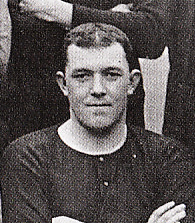
Profile
Sandy Turnbull was one of United's first great goalscorers. He had played for Manchester City before joining United in 1906, making him part of the same early Manchester football traffic as Billy Meredith. At United he became central to the first title-winning side.
Turnbull was a forward with a sharp scoring record and a place in the club's first major successes. He scored important goals as United won league titles and the 1909 FA Cup, giving the club attacking force during the Ernest Mangnall years. Those achievements matter because they established United as a serious national club for the first time.
His career also includes difficult controversy. Turnbull was implicated in the 1915 betting and match-fixing scandal and received a ban. That part of the public record should be acknowledged plainly, but it should not erase the earlier footballing contribution. His story sits inside an early professional game that was far less regulated and far more precarious than the modern version.
After football, his life was overtaken by the First World War. Turnbull served and was killed in 1917, which gives his biography a stark ending beyond the football scandal. For United, he belongs to both sporting history and the broader story of a generation disrupted and destroyed by war.
Turnbull's legacy is therefore complicated but important. He was a major scorer in United's first great team, a player involved in one of early football's major scandals, and a man whose life ended in wartime service. The full profile needs all three elements.
From Manchester City to United's first great attack
Turnbull had already won the FA Cup with Manchester City before joining United in the group of players who crossed the city after the 1905 scandal. His debut came on New Year's Day 1907, when he scored the only goal against Aston Villa. Ernest Mangnall placed him inside Billy Meredith, whose wing play repeatedly created opportunities for the forceful forward.[1]
In 1907/08 Turnbull scored 25 league goals and 27 in all competitions as United won the championship for the first time. He then scored the winner against Bristol City in the 1909 FA Cup final and contributed to the 1910/11 title. These were not antique preliminaries to the club's real history; they were the achievements that first established its national scale.
The 1915 scandal without simplification
Turnbull was among players found guilty by the Football Association after a fixed match between United and Liverpool in 1915. He received a lifetime ban, later lifted posthumously in recognition of wartime service. The finding belongs in the record, but historical context matters. Footballers operated under a maximum wage, with insecure employment and a betting culture surrounding the sport. Context explains conditions without cancelling individual responsibility.
The scandal also intersected with a United side already in decline after Mangnall's departure. By 1915, Meredith, Turnbull and George Stacey were among the few remaining links to the first champions. Competitive league football then stopped because of war, replacing sporting uncertainty with national catastrophe.[2]
The Footballers' Battalion and an unresolved death
Turnbull enlisted in the 17th Battalion of the Middlesex Regiment, commonly known as the Footballers' Battalion. He was killed during the Battle of Arras in May 1917. His body was not recovered, and he is commemorated on the Arras Memorial. The absence of a known grave gives the ending a particular historical starkness shared by many families of the First World War.
His biography therefore resists clean celebration. Turnbull was a foundational goalscorer, a participant in a serious sporting offence and a soldier killed before civilian life could resume. None of those facts should be used to erase the others. United's first league championship and FA Cup depend materially on his goals; the later scandal and war place those sporting achievements inside the unstable working life of an Edwardian professional.[3]
A legacy that must remain complicated
Turnbull cannot be responsibly turned into either a spotless pioneer or a scandal footnote. His goals materially won United's first honours, while the 1915 finding remains part of football's record. The maximum wage and betting culture explain a precarious environment but do not automatically excuse participation. Historical writing is strongest when it preserves that tension instead of choosing the more convenient half.
War then changed the scale of judgment. Military death did not retroactively settle the sporting case, just as the ban should not erase service or loss. The Commonwealth War Graves record places Turnbull among a generation whose bodies were never recovered and whose families lacked ordinary closure. United history contains all of these facts: sporting foundation, professional misconduct and wartime death. Precision requires that the article allow them to coexist.
Scoring before modern documentation
Turnbull played before complete film archives and modern shot records, so the goals carry much of the surviving evidence. Twenty-seven in the first title season and the winner in the 1909 final show repeat production and decisive contribution. They do not reveal every movement, but they prevent distance and controversy from reducing a major forward to a name beside an old team photograph.