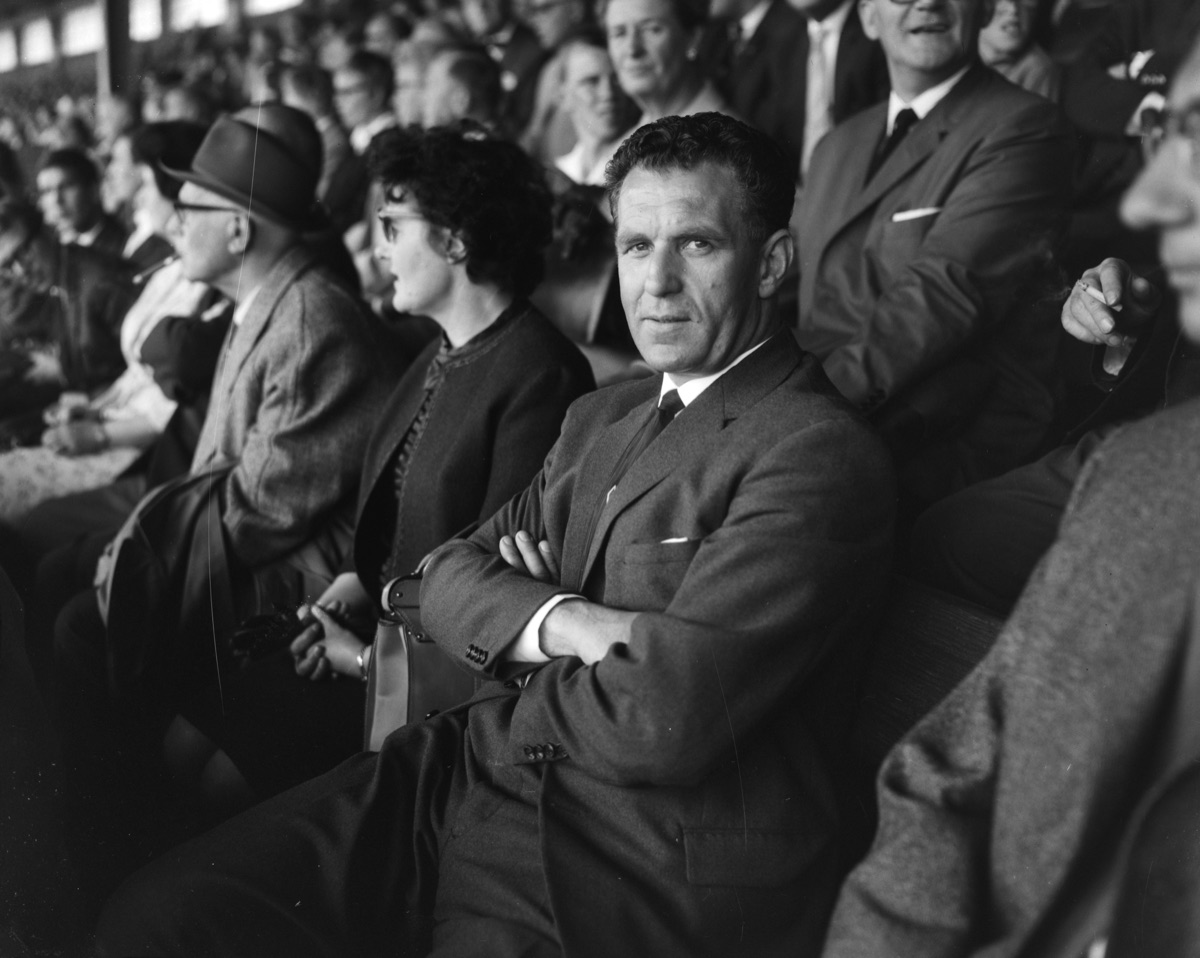
Profile
Jack Rowley joined United from Bournemouth & Boscombe Athletic in the 1930s and became one of the club's great scorers across a career disrupted by the Second World War. That interruption matters. Like many players of his generation, his official record does not fully describe the football he played or the years taken out of a normal league rhythm.
Rowley was a left-footed forward with power, durability and a reliable goal output. He could play as a centre-forward or inside-forward, giving United flexibility across the forward line. His nickname, the Gunner, reflected the force of his shooting and the directness with which he attacked goal.
Under Sir Matt Busby, Rowley became central to the first post-war United team. The 1948 FA Cup win and 1951-52 league title were the high points, but his importance was not confined to finals and tables. He gave Busby a dependable attacking reference while the manager was building a club identity around technique, youth and forward play.
His partnerships with other attackers helped United become less predictable. Rowley could finish moves, but he could also shift position and create space for teammates. In a period before the Babes, he was one of the players who made United dangerous enough for Busby's ideas to win quickly.
After United he became player-manager at Plymouth Argyle and then continued in management. His place in United history is sometimes overshadowed by later forwards, but the scale of his scoring and the era he served make him essential: a prolific bridge between pre-war United and Busby's first champions.
Researched United record
- United appearances and goals: 424 appearances, 211 goals (competitive first-team record).
- Debut and final appearance: Debut: 1937, after joining from Bournemouth & Boscombe Athletic; final appearance: 1955, before joining Plymouth Argyle.
- Main position: Centre-forward / inside-forward.
- Major honours: FA Cup winner in 1948 and First Division champion in 1951/52.
- Important match or milestone: Scored twice in the 1948 FA Cup final and was United’s first player to reach 200 goals.
- Route: Signed from Bournemouth & Boscombe Athletic in 1937; wartime military service interrupted his competitive career.
Research note: Written by John Williams. Last updated: 20 June 2026. Last fact-checked: 20 June 2026. The club record notes that wartime fixtures are excluded from the competitive total.
External evidence
A scoring career divided by war
Rowley signed from Bournemouth & Boscombe Athletic in 1937, but the Second World War broke the competitive career into two parts. He served with the South Staffordshire Regiment and landed in Normandy after D-Day while also appearing in wartime football when service permitted. Those matches are excluded from United's official totals, which is why the recognised 424 appearances and 211 goals cannot represent all the football he played in his prime years.[1]
The distinction is important for statistical honesty. Wartime competitions varied in format and player availability, so they should not be merged silently with peacetime records. They still formed Rowley's experience and physical development before Sir Matt Busby arrived in 1945.
The 1948 final and Busby's first attack
Busby used Rowley's forceful left foot within an interchanging forward line. In the 1948 FA Cup final against Blackpool, United twice fell behind before winning 4–2; Rowley scored two of the goals. The match gave Busby his first major trophy and established an attacking identity before the youth-led championship sides of the 1950s.[2]
Rowley later became the first United player to pass 200 competitive goals and helped win the 1951/52 league title. His nickname, “the Gunner,” described shooting power, but he was more versatile than a fixed penalty-box player. He could shift across the front line, create space and combine with Stan Pearson and other forwards. That flexibility helped Busby modernise a team whose senior players had learned through both pre-war and wartime football.
Player-manager and builder beyond United
In 1955 Rowley moved to Plymouth Argyle as player-manager. He led the club to a Third Division title and later managed Oldham Athletic, Ajax and Wrexham. The Ajax appointment was brief, but it placed an English coach inside a Dutch institution shortly before its most famous tactical transformation. His longer lower-league work showed the same willingness to carry responsibility that had marked his senior United years.
Rowley died in 1998, with later generations often ranking him behind forwards captured more extensively on film. The archive record argues against that neglect: more than 200 competitive goals, two in a classic cup final, a league title and an important place in the first Busby team. His military service and management career add depth, but the central achievement remains footballing—he gave post-war United the goals through which a new manager's ideas became credible.
The missing seasons inside the total
Rowley's recognised 211 goals are already exceptional, but the wartime interruption means they describe a career with its centre removed. It would be wrong to add regional wartime matches to the competitive total, because tournaments and team eligibility were different. It would be equally wrong to read the official number as if six normal league seasons had taken place.
His value to Busby lay partly in having endured that disruption. Rowley returned as an experienced forward able to translate new tactical ideas into goals immediately. The 1948 final made the contribution visible; the 1952 title proved it could sustain a league campaign. Later management extended rather than transformed the same football identity: direct, demanding and prepared to carry responsibility. He is the bridge between United before the war and the winning culture from which the Babes emerged.